
The Morning Assembly

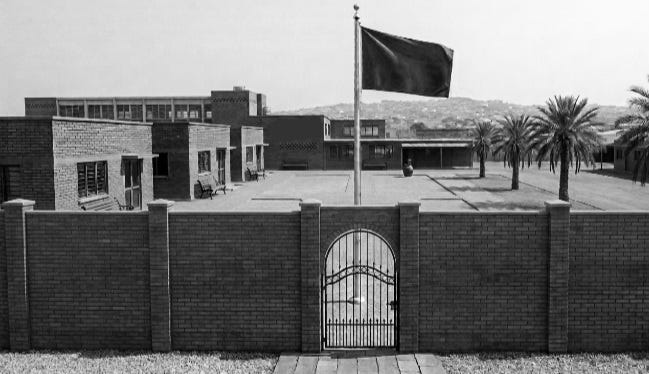
Every morning in high school, at a girls-only school, we stood in perfect rows for assembly. More than two hundred girls, silent and waiting.
The principal, a middle-aged man, treated those assemblies like military inspections. He would walk slowly through the lines, examining each student as though he were searching for evidence of disobedience.
Our uniforms had to be spotless and neatly ironed. Our fingernails had to be trimmed, clean, and free of nail polish. Our shoes had to be plain black. Our socks had to be white.
These weren't simply school rules. They were rituals of control.
Any violation was met with violence.
Sometimes he ordered us to stretch out our hands before striking our knuckles with a heavy wooden ruler. Other times, he wedged a pen beneath the middle finger so it rested across the index and ring fingers, then squeezed all three together until it felt as though our finger bones would snap. If your socks weren't white enough to his liking, or your shoes weren't plain black, he would cane the backs of your legs with the wooden stick he carried everywhere.
Pain wasn't exceptional. It was routine.
What I remember most isn't the fear. It is how ordinary the violence became. Teachers watched. Students watched. Parents knew. Few people questioned it because many had grown up believing that this was simply how children were disciplined. Violence wasn't seen as cruelty; it was seen as education.
After the inspections came the national anthem.
The principal loved that part of the morning. You could see it on his face. Once the punishments were over, he expected us to sing with pride and precision.
I refused to memorize the anthem.
Instead, I deliberately sang it incorrectly, making sure I disrupted everyone around me. It was a small act of rebellion, almost invisible in a crowd of hundreds, but it was mine. Since he insisted on ruining our mornings, I found satisfaction in ruining the one thing he seemed to enjoy most.
Of course, it brought more punishment.
At the time, I couldn't have explained why I did it. I only knew that if someone exercised absolute power over my body, I wanted to reclaim some small part of myself. Refusing to cooperate became the only freedom I could find.
Years later, I think about those assemblies differently.
They were never just about uniforms or polished shoes. They taught obedience. They taught that authority could humiliate you publicly and call it discipline. They taught that pain was an acceptable teaching tool. Most dangerously, they taught children to confuse fear with respect.
That lesson did not begin with our principal.
The belief that children must be beaten into obedience has deep roots in many societies, strengthened and legitimized through colonial systems of education and governance. Colonial schools often prized conformity, hierarchy, and punishment over curiosity, dignity, and critical thought. Those ideas did not disappear when colonial administrations left. They remained in classrooms, homes, churches, mosques, and institutions, passed from one generation to the next until violence became so familiar that many stopped recognizing it as violence.
I don't remember every assembly.
I don't remember every punishment.
But I remember what it felt like to stand in those lines each morning, waiting to discover whether the colour of my socks, the shine on my shoes, or the length of my fingernails would determine how much pain I would carry into the classroom that day.
And I remember that, even as a child, I understood something important: when people are denied dignity, they will often find small, quiet ways to resist.
Mine was the national anthem.
This hit close to home, Mirage. Thank you! ♥️ very well written!
Our assemblies at a co ed school in Aotearoa New Zealand were not as savage as yours, but yes those uniforms had to be the required length, shoes polished, hats, gloves and blazers worn in the street, or else you’d land up in detention. My little rebellion was a non regulation hair ribbon and sometimes to arrive so late I could skip assemblies altogether and slide into class especially if it had been very wet. They used to argue that uniforms were to make the better off kids indistinguishable from the less well off. Nonsense, it was always clear who bought their uniforms second hand and who had new sports shoes and who did not. No, uniforms were and are an instrument of control to induce conformity; many of us rebelled against this though some did not.